

Meet The Hermit: When Pulling Back Is Protection, Not Rejection
Some parts of us know how to stay engaged.
And some parts of us know exactly when we’ve had enough.
This month in the Parts Project, we’re meeting The Hermit — the part of us that pulls back when life feels too loud, too demanding, too full, or too emotionally expensive.
At first glance, The Hermit can look like distance. Avoidance. Disinterest. Disconnection.
But often, it is something much more understandable.
The Hermit is not necessarily anti-people.
It is often anti-overwhelm.
Pulling back is communication
In this first episode of the Hermit series, Renae and Laura explore the idea that all behavior is communication — including withdrawal.
When you pull back, go quiet, stop responding, hide in your office, retreat into your thoughts, or feel the deep urge to be left alone, something is being communicated.
Maybe your system is saying:
- I’m overstimulated.
- I’m emotionally full.
- I can’t tell what is mine and what belongs to everyone else.
- I need space to think.
- I need a break from being needed.
- I need to come back to myself.
That doesn’t mean every retreat is automatically healthy. But it does mean the pattern deserves curiosity before judgment.
Solitude and isolation are not the same thing
One of the most important distinctions in this conversation is the difference between solitude and isolation.
Solitude is chosen. It often feels peaceful, restorative, empowering, or clarifying. It gives us space to breathe, think, pray, create, rest, or simply be.
Isolation often feels different. It may feel lonely, reactive, resentful, numb, or like something is happening to us rather than something we are choosing. Isolation can start as a need for space and slowly become disconnection.
The goal of this work is not to stop needing solitude.
The goal is to notice when space is restoring us—and when it is becoming disappearance.
The exhaustion of being needed
For caregivers, helpers, parents, leaders, and emotionally attuned people, being “needed” can become exhausting.
Not because we don’t love people.
Not because we don’t care.
But because constant availability comes with a cost. If you are often the emotional temperature-setter, the co-regulator, the one holding the mental load, or the one other people turn to first, your system may start craving space with an intensity that surprises you.
Sometimes the longing is not even for productivity.
Sometimes the longing is simply:
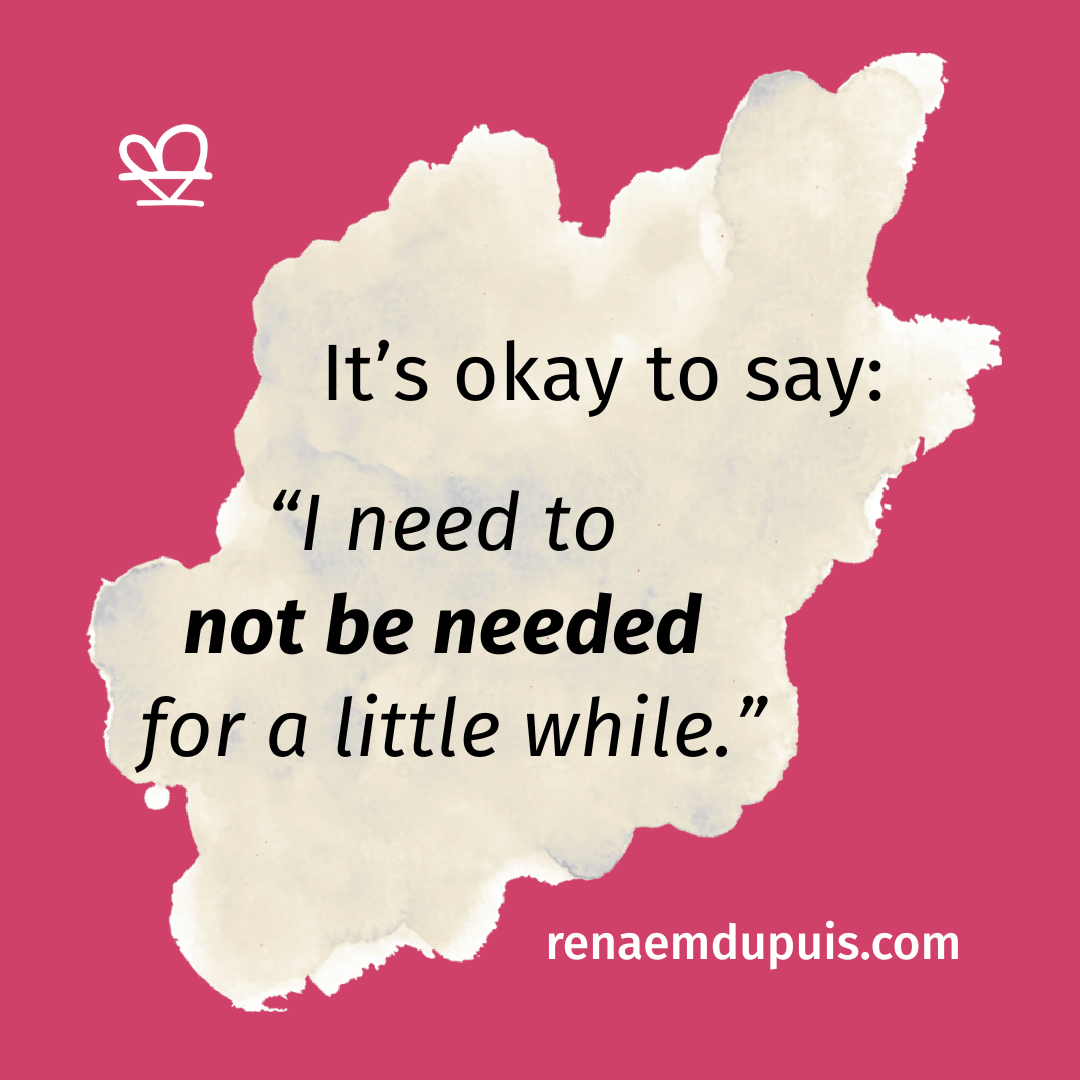
I need to not be needed for a while.
That is not selfish.
That is information.
Intentional space reduces reactive retreat
One of the most healing shifts for The Hermit is moving from reaction to rhythm.
Reactive retreat sounds like:
- “I can’t deal with anyone.”
- “Everyone needs too much.”
- “I’m done.”
- “Leave me alone.”
- disappearing without language
- shutting down because there was no space earlier
Intentional solitude sounds more like:
- “I need some quiet before I respond.”
- “I’m blocking off no-meeting time.”
- “I’m taking care of future me.”
- “I need space so I can come back with more capacity.”
- “I’m choosing restoration before I hit shutdown.”
That kind of space is not disconnection.
It is prevention.
The Hermit may be protecting something valuable
When Renae and Laura talk about what The Hermit wants, the answers are tender and relatable.
The Hermit may want:
- full acceptance of self
- room to think
- privacy
- safety
- quiet
- energy
- freedom from constant input
- a chance to be instead of do
In a world built around doing, producing, consuming, responding, and being available, The Hermit can be the part that says:
I need a place where I am not too much, not too quiet, not too anything. I just get to be.
That is worth listening to.
A gentle place to begin
This week is not about forcing yourself into more connection than your system can hold.
It is about awareness.
Try asking:
- When does my Hermit come online?
- What drains me faster than I admit?
- What are my first signs of pulling back?
- When is solitude restorative?
- When does isolation start to cost me?
- What is this part trying to protect?
The goal is not to make The Hermit disappear.
The goal is to understand it well enough that space becomes intentional, restorative, and connected to return.
Listen to the episode
🎧 Meet The Hermit: When Pulling Back Is Protection, Not Rejection
Try the free practice
The Hermit Micro-Journey #1: Awareness is a free 1-page practice to help you notice your retreat patterns, distinguish solitude from isolation, and name what The Hermit may be protecting.
🧩 Get the free Micro-Journey #1:
https://renaemdupuis.com/product/hermit-micro-journey-1-awareness/
Go deeper
If you want the fuller guided path, the 21-Day Hermit Journey Companion Workbook will walk you through Awareness, Healing, and Integration with prompts, reflection, and gentle practices for space, safety, energy, and connection.
📘 Get the workbook:
https://renaemdupuis.com/product/the-21-day-hermit-journey-companion-workbook/

0 comments