

Whole-Parent Support: Caring for the Caregiver in Complex Seasons
Parenting in complex circumstances asks so much more of you than most people ever see.
You’re reading reports, answering school emails, juggling appointments, holding big behaviors, and carrying everyone’s feelings—including your own—through systems that aren’t always trauma-wise or neurodivergent-affirming. You’re not “just” parenting; you’re caregiving, advocating, translating, and absorbing.
And most days, you’re expected to do all of that on an already-tired nervous system.
Whole-Parent Support at Renae M. Dupuis, LLC was created for you.’
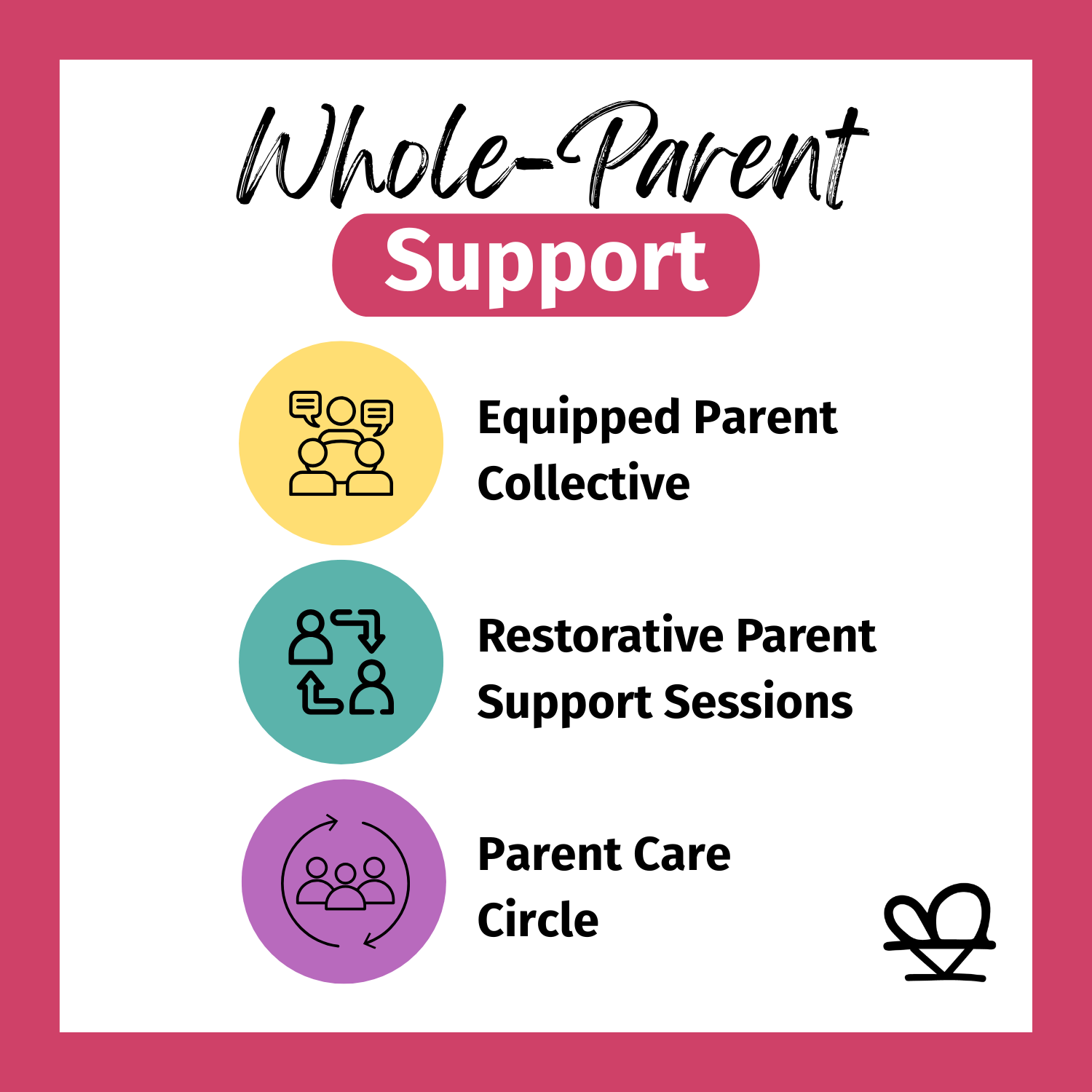
What Do We Mean by “Whole-Parent Support”?
When I say Whole-Parent Support, I’m talking about care that:
-
sees you as a whole person—heart, mind, body, and soul,
-
honors the real complexity of your family and the systems you’re navigating, and
-
walks with you as you build capacity, instead of asking you to chase perfection.
It’s not one more parenting program telling you what you “should” be doing.
It’s a small ecosystem of supports designed around your nervous system, your season, and the actual realities you’re living in.
Because there truly isn’t one right way to be here. That’s why Whole-Parent Support includes three different pathways, depending on what you need most right now:
-
a soft place to land and be held,
-
a practice space to learn and live trauma-wise tools, and
-
focused 1:1 support for high-stakes situations.
Let’s look at each one.
Pathway 1: Parent Care Circle — Being Held

Parent Care Circle is your monthly soft landing space: a place where you are held, witnessed, and supported.
This is for you if:
-
you’re carrying a lot of guilt, burnout, or “I should know better,”
-
you feel like you’re holding it all together on the outside while you’re unraveling inside,
-
you crave a space where someone asks, “How is your nervous system doing?” and actually waits for the answer.
Inside Parent Care Circle, you can expect:
-
Trauma-aware, shame-free support. No gold stars for suffering more.
-
Gentle regulation practices that fit into real life (short, repeatable, and capacity-honest).
-
Steady community rhythm so you’re not trying to self-regulate in isolation.
Think of it as a monthly exhale for the part of you that’s always “on.”
Pathway 2: Equipped Parent Collective — Being Equipped

Equipped Parent Collective is the practice space for parents who have read the books, attended the trainings, and still feel stuck in the gap between “I know the theory” and “I can actually live this on a Tuesday after three meltdowns.”
This space gives you:
-
Trauma-informed training in bite-sized, realistic pieces
-
A rhythm of learn → try → come back and process → adjust
-
Supportive feedback so you’re not experimenting alone
Instead of handing you more information, the Collective helps you practice—with people who understand that your home, your child, and your nervous system are all uniquely wired.
Pathway 3: Restorative Parent Support Sessions — Being Partnered (1:1)

Sometimes your situation feels too high-stakes to navigate without focused, one-on-one support.
Restorative Parent Support Sessions are for those seasons:
-
navigating school and special education,
-
making decisions around diagnoses and professional opinions,
-
holding big behaviors at home,
-
or coordinating multiple systems (school, mental health, child welfare, medical, justice) at once.
In these sessions, we:
-
Slow things down and map what’s happening.
-
Name the patterns and priorities so you’re not spinning in 100 directions at once.
-
Co-create 1–3 aligned next steps that match your values and your capacity.
You leave not with a giant to-do list, but with language, tools, and a plan you can actually move with—supported by follow-up notes and, if needed, a short or deep-dive series.
How These Pathways Work Together
These three supports aren’t competing offers—they’re parts of a larger ecosystem designed to keep you resourced enough to stay in the advocacy and caregiving work you’re already doing.
You might:
-
start with Parent Care Circle just to have a place to land emotionally,
-
add Equipped Parent Collective when you’re ready to practice trauma-wise tools more actively,
-
and book Restorative Parent Support Sessions when a specific season or decision feels too complex to hold alone.
You’re welcome in any or all of them, depending on what your nervous system, your schedule, and your season are asking for.
Who Whole-Parent Support Is For
Whole-Parent Support is especially for you if:
-
you’re parenting in the context of trauma, neurodivergence, disability, or complex systems,
-
you’re tired of being treated like a “case” instead of a human,
-
you’ve tried to fix everything alone and your nervous system is fried,
-
you’re longing for someone to say, “No, it’s not just you—and no, you’re not failing.”
Underneath all of this is a simple belief:
It’s too much for one nervous system alone. You deserve support, not scrutiny.
Your Next Best Step
If you’re curious but not sure where to start, you don’t have to figure it out on your own.
Here are two easy options:
-
Explore the Whole-Parent Support Services page
Read the short overview and see which pathway (Care Circle, Collective, or 1:1 sessions) sounds most like the support you’ve been craving.
👉 Whole-Parent Support -
Ask: “What does my nervous system need most right now?”
-
To be held → Parent Care Circle
-
To be equipped and practice → Equipped Parent Collective
-
To be partnered through something high-stakes → Restorative Parent Support Sessions
-
Whichever doorway you come through, the heart of Whole-Parent Support is the same:
You and your nervous system matter here, too.